Formula Indie Sessions : Interview with WATCHA

What is your earliest memory connected to music?
A Philips N4520 Reel-to-Reel Tape Recorder sat in our living room. The object itself was already fascinating — those large reels of magnetic tape delivering music. More than a record spinning, it was two reels spinning! Technology has always captivated me. I was also lucky to have a brother who was passionate about music. He gave me access to his vinyl records and CDs, and shared that passion with me. Music has accompanied me at every moment since. That first sensation — the meeting of technology and curiosity — remains just as strong and essential today.
—
How did your passion for creating music begin?
I have always been drawn to exploring different media of expression, combining something spontaneous with an underlying logic. Music offers both: picking up a guitar, playing chords, and letting words come to give meaning to the melodies. Writing music, organizing arrangements — there is a logical dimension that allows it to be recorded and transmitted to others. These structured creative steps are essential to me. I apply the same approach to visual art and architecture, two other passions that hold an important place in my life. I also had the great fortune of discovering musical composition through the career of my godmother, Murielle, a film composer based in Los Angeles. Her ease in recording and composing, her incredible home studio — it all sparked a true fascination with music and its creative process. Fortunately, I quickly felt at ease with the tools, and that allowed me to connect with emotion through the work.
—
What’s the story behind your current music project?
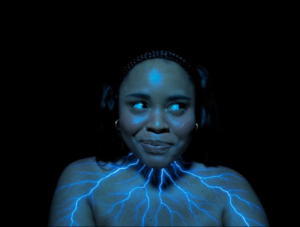
I come from a world where the web did not exist. I have lived through its extraordinarily rapid development — social networks, the rise of AI — and all of it leaves me deeply thoughtful about how we use these things. The thread running through my projects leads back to the dawn of time, when we were nothing more than microscopic single-celled organisms. A way of not forgetting where we come from, and of remembering that everything we create has a direct impact on our lives. The project WATCHA (We Are The Cloud High Atmosphere) explores the reality that we are immersed in a virtual world that has become an unavoidable part of our daily existence. And yet we are not made of bits — we are made of DNA. But when you think about it, we are made of energy: what if our destiny were ultimately to become nothing but waves? At its core, this project is set at 69 BPM, meant to be sung in a soft, rather low voice — a blend of sensuality that makes listening pleasurable and invites a reconnection of the senses. Three songs so far have begun this exploration, open-ended in time and genre.
—
How would you describe your sound to someone who has never heard your music before?
My musical universe is conceived like a visual art project. I explore a wide range of genres and do not follow conventional codes. This “free” approach is something I have practiced since adolescence, allowing it to evolve alongside my other projects. Each song is spontaneous. Often I pick up my guitar or start building an arrangement, and the lyrical ideas come quickly. Then it is about making choices — keeping what fits the moment. It can be disorienting, but I see these songs as frozen instants that together form a body of work to be listened to across years.
—
What is one thing you’ve learned that completely changed the way you make music?
In the beginning, self-taught and alone in the basement of my building, I did not have any of the tools that exist today. It was therefore the evolution of technology and the learning of technique that fundamentally changed how I make music. I started composing on Cubase, running on an Atari Mega STE with a Roland JV-80 keyboard. It was a remarkable discovery — composing via MIDI, building tracks, applying effects, even writing scores. My godmother also introduced me to analogue recording by gifting me a Fostex 280 four-track multitrack recorder. On that machine I made my first album, *Tout’amour*, which was played during an exhibition. Learning the craft of sound engineering and arrangement gave me the freedom to compose at any hour, with no constraint other than producing a sound good enough to be released.
—
What tools, instruments, or software are essential in your creative process?
Today: a MacBook Pro, Logic Pro, an Arturia KeyLab 49 MIDI keyboard, a Focusrite Clarett 4 Pre audio interface, a RØDE microphone, and my PRS SE guitar. A quiet, discreet space.
—
Which indie artist or song are you loving right now?
For some time now, I have enjoyed letting myself be guided by a wide variety of artists — I cannot settle on just one. I need to move across many playlists, the overall atmosphere being what matters most. Jazz, electronic, the nineties, rock… Zen music in the morning helps me start my days more serenely. I also return regularly to Tom Waits, Nine Inch Nails, Dominique A, Radiohead, UB40…
—
How have your personal experiences influenced your music and artistic vision?
Just as in my reflective material practice — a visual art project created through performances featuring wine and fire, accompanied by music — my experiences and observations are a constant source of inspiration. I am among those who feel things deeply, touched by the world and by the lives of others. Through a long effort to understand my own way of functioning, which proved to be arborescent — branching in every direction — I have come to see myself as an observer with many facets. Being able to work across different media means I have never confined myself to a single form of expression. What matters is to create. What emerges no longer belongs to me — it finds its own way. I have lived through an emotionally intense life that I would not wish on anyone. This has led me to choose techniques where I place myself at risk. In music, however, I have not yet chosen to write songs that are too dark — though the soundtrack for the exhibition *Le bonheur torture* did use recordings of my own cries. Transcending pain into something mysterious and intriguing is also a way of accepting difficult moments and converting them into positive energy.
—
What emotions or messages do you hope listeners take from your work?
To bring any emotion at all to someone is already an achievement — to make them smile, to make them dream, to give them a starting point for reflection, or simply for relaxation. The work itself is what matters most; each person takes from it what they need. On a broader level, the development of technology — which ultimately serves those who can finance it — does not seem to be bringing people closer together. If anything, it creates distance. Perhaps becoming aware that we are fundamentally one could allow a reconnection with more essential things. Moving beyond the instinctive state that shaped us, toward a slightly more balanced world. But then, does the evolution of the world not follow its own course — with us as just a passage through it?
—
What’s the most important lesson music has taught you so far?
That in every moment, music is there for us. Whether in nostalgia, in joy, in letting the body move freely, or in bringing people together. Does everyone not have a song that ties them to a moment, or to a person?
—
What is a dream venue or festival you would love to perform at?
I have not performed much in public, preferring intimate settings. Working in the studio, producing, and releasing music is already wonderful in itself. Sometimes, watching artists perform before thousands of people, I find myself thinking about the work and the entire team required to make that happen — the logical part of how my mind works. I remember Mich Gerber performing in the Bex salt mines in Switzerland — an exceptional place for an intimate concert. Somewhere like that would be a truly extraordinary experience.
—
If you could collaborate with any artist, past or present, who would it be and why?
Peter Gabriel. His voice, his compositional arrangements and atmospheres, and his philosophy of life.
—
Where can our listeners follow and support your music? (Website,Spotify, IG, links)
You can find me on most streaming platforms — [Spotify](https://open.spotify.com/intl-fr/artist/49Gso5Kgbp8JRIByK176Zo?si=gzFdxRCFRBKEBaM3npzCoA) and Apple Music.
Two websites allow you to follow my projects: www.mikee.ch/musique
and the current project, www.watcha.cloud
—
Looking toward the future, what’s your dream for the next chapter of your musical journey?
Music being part of my daily thoughts, I will continue the WATCHA project. It accompanies deep reflections and will allow me to channel the themes of the virtual and the return to the human. My dream would be to find a measure of inner peace — and for everything I invest in artistic sharing to bring moments of surprise and pleasure to others; and, for those who wish to go further, a reflection on the infinite possibilities of contributing to the evolution of the world, and of allowing ourselves the space to truly listen to one another.
—
What do you hope listeners will discover about you along the way?
I would be deeply moved if people could trace a common thread — a set of broader thoughts expressed across different media. Observations that sometimes arise despite myself, woven through many stories, some joyful, some less so. A testament to a time when hope always ensured that each moment was a step toward a certain kind of evolution.
If you want here you can add a representative Youtube video to insert below the interview 🙂
Link
An animated song
My YouTube channel