Formula Indie Sessions _ Interview with Quarto ao Lado

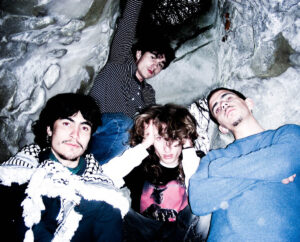
Quarto ao Lado is a band from Porto Alegre, Brazil, formed by Carlo Gianlupi (drums), Francisco Cezimbra (bass), Kelvin Machado (vocals, guitar, and acoustic guitar), and Sara Oliveira (vocals). The group began in 2021 after the members met in the Music program at UFRGS. Influenced by the sounds of artists such as Radiohead, Clube da Esquina and Big Thief, the band seeks to blend contrasting elements to create a dreamlike and melancholic atmosphere. They are currently in the process of releasing their debut album, recorded entirely independently in the members’ homes between October 2022 and August 2024. The album, which contains 12 tracks, is scheduled for release in the first half of 2026.
What is your earliest memory connected to music?
Kelvin: My dad was, and still is, a bass player, and when I was a baby he had a band called Bixo Grillo. I vividly remember being on stage at one of their shows, pretending to play with a plastic guitar. I was probably around two years old. After the show, I basically had to keep my finger in my mouth because I had given myself a blister from pretending to play too much.
Sara: This memory gets a bit mixed up with what my parents tell me, but I remember singing My Heart Will Go On by Céline Dion for months after watching Titanic with my mother. I remember being in my aunt’s garden, with my cousins listening to me, with practically nonexistent English, of course, since I was about three years old.
How did your passion for creating music begin?
Kelvin: I’ve loved playing music since I was little, but I think my passion for creating music really started at the beginning of the pandemic, shortly before I entered university. I found in it a way to express myself, to process what I was feeling, and to translate what was happening around me into music.
Sara: I believe it all started with writing and humming. I think I learned how to hum and sing before I learned how to speak. Many children do that, but my parents always encouraged me to keep going, and here I am. Even before I knew how to write, I used to pretend to write texts and read them to my father, while also inventing songs. Later, at the age of eight, I had the opportunity to learn music in a more formal way at the church I was part of until I was sixteen. It taught me a lot and gave me tools that I still use today to write and sing.
What’s the story behind your current music project?
Kelvin: Sara, Francisco, and I met during our first semester in the Music program at our university, UFRGS. This was in 2021, during COVID and social distancing, so all of our classes were online. Still, we were eager to create, so we started writing songs and making demos remotely by chatting via whatsapp, holding meetings and trying to produce online via Discord. Looking back, it’s really crazy how we managed to come up with so many songs during that time. It was only after a couple of months that we actually met in real life, invited Carlo to join us as our drummer, and started rehearsing and creating together in a more traditional way.
How would you describe your sound to someone who has never heard your music before?
We like to create atmospheres in our songs, telling stories not only through lyrics but also through a wide range of instrumentation and dynamics that, hopefully, create a space that feels intimate and immersive. We’re influenced by artists such as Radiohead, Clube da Esquina, and Big Thief, as well as a wide range of Brazilian music, and we try to blend and reshape these influences in different ways.
What is one thing you’ve learned that completely changed the way you make music?
Kelvin: I think a real breakthrough moment for me was when I started messing around with alternate tunings on the guitar. It completely changed the way I see the instrument, making familiar shapes, paths, and chords lead to totally unexpected results. It feels like a happy-accident machine, an endless and fertile field for experimentation.
Sara: I learned to build a routine and to set aside time to write and sing, which has helped create space for creativity to emerge in other moments and has really changed the way I look at and make songs. It’s about accepting the moment when something is triggered and letting it flow. After I understood the importance of carrying a small notebook to write down ideas, or using my notes app and voice recorder, without limiting myself only to scheduled study sessions, I became able to create more easily and to enjoy the process more than the final product.
What tools, instruments, or software are essential in your creative process?
Kelvin: Almost all of the songs on our album were composed on a nylon-string acoustic guitar, with vocals playing an important role in the songwriting process. From there, we arranged and developed the songs, gradually adding more instrumentation. In the end, the songs generally consist of a combination of acoustic and/or electric guitars, bass,
drums, and vocals. Throughout the record, they also feature clarinets, double basses, synths, percussion, and samples. We record everything on Ableton Live, and the recording and arranging processes tend to blend together, since we usually keep trying out new ideas, instruments and sounds as the songs take shape in the homestudio.
Which indie artist or song are you loving right now?
Kelvin: I’ve been really into Hannah Frances’s latest album, Nested in Tangles, which came out last year. It’s full of great songs, beautiful instrumentation, and her guitar playing is amazing. I highly recommend it!
Sara: I have been listening to the singer Silvana Estrada for a long time. I even sang one of her songs, Te Guardo, in the entrance exam for university. I keep returning to her work, which always moves something different in me. At the moment, I’m also kind of obsessed with Maria Arnal, Juana Aguirre, and Uma. They all work with words in a way that either tells stories or challenges formal structures, moving away from phonemes and treating words as something living and rhythmic, which supports the creative process of other elements in a song.
How have your personal experiences influenced your music and artistic vision?
Kelvin: Everything I create ends up reflecting what’s happening with me or around me. As I mentioned before, the band was born during the pandemic, and almost all the songs on our debut album were written during that time, when we were all trying to make sense of this new way of living. I had also recently moved out of my parents’ home, living in a different city, so I was questioning where I belonged. I think a lot of that searching ended up shaping the album.
Sara: Everything I do revolves around who I was as a child and all those memories that stay with us forever. My work is deeply rooted in memory, particularly childhood memories. I use songs to recreate scenes from my early years, and also as a means to
recover and preserve moments that will never come back. I see my music and artistic vision as nothing more than a patchwork quilt of my childhood self.
What emotions or messages do you hope listeners take from your work?
Kelvin: I don’t really expect anything in particular. I think the best kind of music is the kind that evokes something different in each person. I just hope our music can be a space for people to reflect, to wonder, and maybe find their own answers.
Sara: Just as Kelvin said, I don’t expect anything in particular. Obviously, music is about sharing, it’s something collective, so I really believe in putting something out into the world for it to become something else and take on other interpretations. I just hope that someone, somewhere, enjoys it and is able to reinterpret what I do through their own experiences.
What’s the most important lesson music has taught you so far?
Kelvin: I think it has taught me how to collaborate, especially in a band setting, where each of us has different opinions and tastes. It’s taught me how to use that diversity to reach a place none of us had envisioned or expected before.
Sara: It taught me that other people can look at my work with care and affection and bring it to life in ways I couldn’t do on my own. I believe that no one gets anywhere alone, and how wonderful it is that, through music, we can find these moments of collectivity and creation in such an individualistic world.
What is a dream venue or festival you would love to perform at?
Kelvin: The Primavera Sound lineup is always great, and it would be really fun to be part of it someday. Lollapalooza also always brings amazing artists, and lately here in Brasil they’ve been paying a bit more attention to the independent scene, which is super important for up-and-coming bands. So yeah, performing in one of those would be insane.
If you could collaborate with any artist, past or present, who would it be and why?
Kelvin: Oh, that’s a hard one. It’s almost impossible to choose just one, but if I really had to, I guess it would be Luis Alberto Spinetta, El Flaco. For me, he’s one of the absolute greats. He took so many different sounds, structures, and surreal, poetic lyrics and
transformed them into something entirely new, something we hadn’t really seen before here in Latin America. On top of that, he had such a unique voice and an instantly recognizable way of playing and writing. His music feels personal and expansive at the same time, and it’s something that keeps inspiring me over and over again.
Sara: Definitely Silvana Estrada or Juana Aguirre. Silvana tells stories and speaks a lot about home, memories, and love, something I carry into my own work. Her voice moves me in such a beautiful way! Juana is a more recent discovery, showing me incredible new possibilities and experiments, and approaching writing in a way that fascinates me. The same goes for her live performances, which I’ve only seen on video so far, but they seem to be utterly immersive and transcendental.
Where can our listeners follow and support your music? (Website,Spotify, IG, links)
We’re mostly active on Instagram, you can follow us at @quarto.aolado, which is also our handle on TikTok. Our music is available on all platforms and you can find our latest single through this link: ditto.fm/porta. If you want to support us more directly, check out our Bandcamp, at quartoaolado.bandcamp.com. We’d really appreciate it!
Looking toward the future, what’s your dream for the next chapter of your musical journey?
We’re finishing up plans for the release of our debut album, which will be out in the first half of 2026, with a single coming out shortly before it. We really hope people listen to it and connect with it in some way, finding something of themselves within these songs. We’ve been working on this album for the past couple of years, so we’re really excited to finally share it with everyone. We’d also love to play a lot of shows with this project, maybe plan a tour here in Brasil and play with other local bands along the way. Hopefully we can make it happen!
What do you hope listeners will discover about you along the way?
I hope listeners discover the layers in our music, the care in the arrangements, the details in the lyrics, and the intention behind the atmospheres we create. I also hope they come to understand where we’re coming from, not just emotionally but culturally. There is so much powerful and meaningful music being made outside the usual cultural centers, and we are part of that landscape.