Formula Indie Sessions _ Interview with O Jardim Subterrâneo

What is your earliest memory connected to music?
I believe it started when I was five years old, when my mother put my younger brother to bed. She would usually sing “Trem das Onze” by Demônios da Garoa, “João e Maria” by Chico Buarque, and other songs by artists from past eras. Now, with music playing on the radio or stereos, I remember hearing “Faroeste Caboclo” by the band Legião Urbana around 2001 or 2002. It was also very common to hear “Espera na Janela” by Cogumelo Plutão or “Já Sei Namorar” by Tribalistas. Fortunately, music has always been present in my home.
How did your passion for creating music begin?
During my adolescence, there were already signs that I would lean towards this, as I spent hours listening to music on CDs that a friend of mine from the 2000s made in a, shall we say… alternative way. In addition, I spent all day in front of the TV watching music videos on a local TV channel called TV União and listened to a lot of Green Day, Avril Lavigne and Blink-182. I always imagined myself playing in a rock band similar to these and put on pseudo-shows in my living room – complete with air guitar and everything. In 2012, I started playing bass and, shortly after, began composing some things sporadically. I still have notebooks with a good portion of what I wrote in the beginning.
What’s the story behind your current music project?
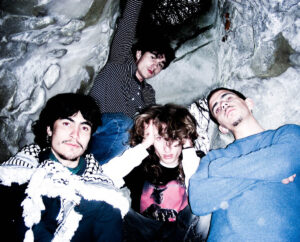
After I started playing in musical projects as a teenager, many ideas emerged. I showed them to the other members, but hardly any fit the project, which left me a little demotivated. A decade passed, and precisely during the pandemic, I began to feel confident enough to use these ideas that had been discarded in other projects and started recording them myself. I learned to mix and produce during this time. Since I had never done anything like it before, I released a lot of inconsistent material that, even with recognition from some names in the Brazilian alternative scene, didn’t really take off. Time passed, I matured, and I had the idea to try again, this time as O Jardim Subterrâneo. It’s a much more musically mature project with a more well-defined concept, and it includes a backing band for live performances.
How would you describe your sound to someone who has never heard your music before?
Noise disturbance.
What is one thing you’ve learned that completely changed the way you make music?
First, not relying solely on chords to create melodies and, most importantly, learning at least the basics of mixing. These two things have helped me immensely to produce music in a more organic way and outside the conventional mold of “verse/chorus/verse/chorus/bridge/chorus” – I couldn’t care less about that.
What tools, instruments, or software are essential in your creative process? I’m not someone who’s very attached to brand names or anything like that, because my philosophy is more geared towards “if something works, that’s enough.” Sometimes other musician friends talk to me about guitar brands, pickups, and I simply don’t care. With that as a starting point, I believe you can use a guitar, an interface to connect it to a computer or smartphone, and any recorder for vocals (it can even be the smartphone’s own recorder). You can simulate bass with the guitar just by lowering the pitch to -12, so you don’t necessarily need one to record it. Regarding DAWs, I’ve used Audacity (which I don’t recommend to anyone for more complex work), FL Studio (good, but more geared towards beat producers), and Reaper – currently my favorite DAW and the only one I use.
Which indie artist or song are you loving right now?
I’m not sure if I can call them exactly indie, but I’ve been listening a lot to the work of Arrigo Barnabé, Fausto Fawcett, Hermeto Pascoal and Zéu Britto. They are big names in avant-garde Brazilian music.
How have your personal experiences influenced your music and artistic vision? In the beginning, I even wrote more about relationships, heartbreak, and more romantic songs, but nowadays I no longer have any connection with that type of writing. I prefer to talk about everyday situations or psychedelic experiences.
What emotions or messages do you hope listeners take from your work? I don’t know the answer, because, for me, music is subjective and everyone will have their own interpretation according to their individual experiences. I just hope you enjoy it and continue to follow my work.
What’s the most important lesson music has taught you so far? Everything has its time.
What is a dream venue or festival you would love to perform at? Glastonbury and Rock in Rio.
If you could collaborate with any artist, past or present, who would it be and why? Several names come to mind, and I imagine most of them would be quite problematic, but I would say Lou Reed. My current worldview is very similar to what he portrayed in his lyrics and interviews. As honorable mentions, I would suggest Júpiter Maçã, Rogério Skylab, and Belchior.
Where can our listeners follow and support your music? (Website,Spotify, IG, links) It’s available on all digital platforms, such as Spotify, Apple Music, Bandcamp, YouTube, and others. It’s easy to find.
Looking toward the future, what’s your dream for the next chapter of your musical journey?
In the underground music scene, there’s usually not much room for dreams, as they die immediately when faced with the reality of independent artistic creation. But, in an ideal world, I could say it would be a pleasure to travel around Brazil showcasing my work.
What do you hope listeners will discover about you along the way? It will be worthwhile for you to accompany me.