Formula Indie Sessions _ Interview with Lucky Came to Town

In some old cold boxcars, at the pace of an old steam train, Lucky travels steadily through the Rocky Mountains. At his side is that old worn-out guitar with which he tells his stories to his fellow boxcar riders. Amid his ride, in late 2019 Lucky’s steam train came to a sudden stop…..
The tracks were snowy and there was almost no way through. Lucky pulled his vest up a little higher and jumped off the train. He said goodbye to his fellow boxcar riders and wished them good luck. Together with three loyal travelers, he moved on…
Looking for stories, looking for a path through those impenetrable Rocky Mountains.
There he met fellow outlaws on the run from the law. And he heard new stories about hopeless fools in love and who were chasing their dreams. Stories of men and women with high hopes, hoping that their luck would soon turn.
With a bluesy voice, he sings their stories. Folk songs about dancing girls and ghosts who wander along the banks of the Mississippi,…
He made new friendships and forged new bonds. Lucky boarded the train again, accompanied by his three loyal friends and two new faces.
Ready to start telling the stories again.
Roots in folk, blues, country…. pure Americana, that’s Lucky Came to Town. Heartfelt and mesmerizing lyrics, beautiful melodies, and blissful harmonies give the sometimes dark lyrics just a little more color. It’s Americana from Belgium…
As others described it:
“They bring us musical stories that can be described as excellent Americana” Freddie (rootsville.eu)
“Great band with very nice harmony vocals and passion for their music” Johan Philipsen – Time Switch (Radio Venray)
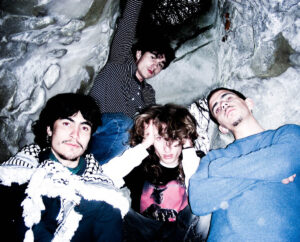
Lucky Came to Town is
- The Storyteller: Kim Van Weyenbergh – Vocals and Guitar;
- The Key Keeper: Dimitri Laes – Keys;
- The Backseat Driver: Bart Steeno – Drums;
- The Devil’s Backbone: Joost Buttiens – Bass;
- The Girl of the North Country: Annemie Moons – Vocals and Harmonica;
What is your earliest memory connected to music?
I remember growing up with a guitar in de corner of my parents’ bedroom. That six string always fascinated me. I got my own classical guitar, that I used to sing along with Springsteen’s “Born in the USA”.
Music was always there when I was growing up! I still remember that while getting ready for school, the Belgian national radio was always playing. Back then it was still called Studio Brussel (StuBru now), and I loved waking up!!
My dad used to manage Derroll Adams, so that’s probably the earliest music connection.
For as long as I can remember, there was always music in our house… . Whether it was Derroll, Mike Oldfield, Bruce Springsteen, Cock Robin, The Stones, Sade,… there was always music!
How did your passion for creating music begin?
It began for real somewhere in 1991. I had the chance to meet the legendary folk singer Ramblin’ Jack Elliot. He played guitar in our garden and I was amazed what that six string piece from my parents’ bedroom could do.
I started playing not so much later. I did those old folk songs from Woody Guthrie, Lead Belly… , but after a while I hated those songs. It wasn’t the music I was listening to on the radio. There was John Hiatt, Nirvana, Pearl Jam on the radio, so I moved forward to The Rolling Stones (never liked The Beatles), Iggy Pop, Bruce Springsteen, R.E.M.,…
I can’t remember why or when I started writing my own songs… . At a certain time it was just there.
I was a teenager looking for a place where I’d belong. I was defining who I was and what I wanted to do, and my guitar and voice quickly made it clear for me. Those early songs were much like Woody Guthrie and Dylan,… campfire songs.
What’s the story behind your current music project?
Lucky Came to Town started as an escape of playing solo. I played solo for almost 15 years, and it was an amazing time! I played everywhere I could and also crossed the Atlantic to play the open mics of New York, Chicago and Atlanta. It was a bold move, but I survived and got more confident about the songs I wrote.
After near 15 years playing solo, I felt that what I wanted to do with my music and songs, could not be done on my own. I wanted to build something bigger, but still honest. So I surrounded myself with a group of musicians who shared the same vision.
We started in our garage and my wife joined to sing, with my 2 year old daughter on the arm, and that was the beginning of Lucky Came to Town!
Lucky started as a folk-country style band, but I wasn’t looking for that polished Nashville country sound. I wasn’t interested in the Californian ‘Eagles’ sound. I wanted raw Americana, folk storytelling, and the band perfectly filled in everything!
As of today, we are a six-piece band with two voices up front, more voices in the background. Songs full of characters, ghosts, highways, heartbreaks, and small triumphs. It’s a band built on friendship, harmony, and the stubborn belief in that stories matter.
How would you describe your sound to someone who has never heard your music before?
We play americana. That’s the short version.
The longer version is much more nuanced because there are a lot of different influences. Yes, there’s a unmistakable country feel, but without all the standard country tropes, and different music fills. There’s no true country twang, so let’s call it alt-country.
There are a lot of folk influences too. I blame my Dylan, Guthrie, Lead Belly background. And finally, there’s some bluegrass and even a little bit of grunge. I grew up in the nineties and I can’t deny what that did to me musically! 😊
What is one thing you’ve learned that completely changed the way you make music?
There were some albums that absolutely turned my world around as a musician. When I started out, I was into Bob Dylan, Nick Drake, the ‘Nebraska’ Springsteen and a little bit of Neil Young.
I was very folk minded before I came across Ryan Adams’s music, I think “Heartbreaker” was the first I picked up. But it might as well be “Pneumonia” from his earlier band Whiskeytown. It opened a new world to me, how I wanted to write about emotions, how I wanted to sing…
Around the same time I picked up “Heartbreaker” there also was “Anodyne” by Uncle Tupelo. That was ‘the’ album that fully draw me into the alt-country mood and created the sound I wanted to strive for. I was all about: “Not falling into the standard country tropes” I tried to do my best, but it was really hard.
Around 2006, I was broken hearted, and I played in Ghent. After the show I mingled in the crowd and got to talk to people from the audience. Someone compared my style of music to Josh Ritter. The very next day I went to my local record store and bought everything I could find from Josh Ritter. His style of writing was very similar to Dylan, very poetic and very story driven and it was very diverse from “Heartbreaker”. It felt much closer to what I was trying to tell in a language that wasn’t my own.
“Heartbreaker” was all about opening up and showing your emotions adn your thoughts about things. It’s hard for a songwriter to open up like that, and Josh Ritter showed me how to do it in a very unique way.
At the same time I got into Josh Ritter, I went to see Steve Earle live and that was it for me.
A ****** rebel! I instantly knew what I wanted to do! He bites, scratches, and leaves his mark, like no-one else. He takes a political stance like a modern day troubadour, like a modern day Guthrie or Dylan.
I never wanted to do what others did, I always wanted to create my own sound and stories and thanks to Steve Earle I’m doing exactly what I want.
Two final album that completely changed my view on music are probably “Tonight at the Arizona” and “The Felice Brothers” by The Felice Brothers.
They stripped everything and let the emotion take over. Those two albums had so much depth, so much emotion… I still cry while listening to those two albums, because every note not played is pure perfection. Those albums breathe and live life.
Both of them were crucial for me as a songwriter and storyteller
What tools, instruments, or software are essential in your creative process?
Just me and my guitar, a rhyming dictionary or to make it easier the rhymezone website.
Which indie artist or song are you loving right now?
What is indie? If indie is:
- stubborn, political, activist, rebellious
- completely in control of his own artistic choices
- averse to Nashville formatting
- averse to commercial country
I’d pick Steve Earle, Colter Wall, Tyler Childers, John Moreland or for sure Jason Isbell and Sturgill Simpson.
If not, it would pick some others:
Ken Pomeroy (I love her voice so much), Benjamin Tod (his honesty comes close to Ian Felice), S.G. Goodman, Ian Noe, Charles Wesley Godin, James McMurtry (his latest album OMG), Josiah and the Bonnevilles, Leon Majcen, A Murder in Mississippi, Kit & Caboodle, Courtney Marie Andrews, Jesse Welles, Matt Andersen, Margo Cilker, Jonathan Peyton, Race Ricketts, Vincent Paolizzi, Levi Turner, Sierra Ferrell, Kashus Culpeper, MJ Lenderman, Tony Leonardi, Nite Chimp, Lord Jane, Joshua Vincent…
I can go on for hours!!!
How have your personal experiences influenced your music and artistic vision?
A lot!
Most of the songs I write are affected by situations that I got in, things I read or saw on TV.
I remember writing songs about being angry about the elections once or writing songs about 9/11.
In my early years, it was very open and not well hidden. After years of practice, reading novels, analyzing song lyrics, I managed to hide the true message of a song much and much better! But still everything is very personal because it touched me one way or another.
Let me take a song like “Going Back” which is on our first album, it’s a song about alcohol problems. I’ve seen alcohol destroy the lives of good childhood friends, I’ve seen how it affected people who were very close to me. I hide it in a story of a drunken musician, but there’s a deeper truth beneath it all.
What emotions or messages do you hope listeners take from your work?
It changes for every song we play…
Just listen close and try to discover the hidden messages.
“Oh, Loretta” is not just a ballad of a woman named Loretta, no it’s a cry against partner violence.
“Coal Blues” is not just a mining story, it’s a story about endurance, migration and dignity.
“Soulfire” is more than just a stomp and holler song, it’s an anti-racism song. It’s a song about standing up for what you believe in!
What’s the most important lesson music has taught you so far?
Keep listening to new music, keep your eyes and ears open… There’s so much good music around, but you need to keep your eyes open because it won’t come by itself.
I hate it when people say: “There’s no more good music! It was so much better back in the 60’s, 70’s or 90’s.” My answer will always be the same: “That’s not true, there’s so much good music, the problem is that you need to go out and listen! Make an effort to find it, because it is there!”
That’s the beauty of today! The internet, or Spotify brings it so much closer to you than ever before.
Yes, the music industry has changed! But it’s giving us a much bigger world!
What is a dream venue or festival you would love to perform at?
Anywhere I can touch the heart of a listener.
I prefer a small stage over any big stage. If only one person comes to me afterwards and tell me: “That song you played, it really touched me it meant something to me!” Then my job is done!
Of course, there some festivals or venues that would make me extremely happy. Belgium is home to great festivals. I’d pick Goezot, Dranouter, and Midzomer (in my hometown Louvain), perhaps Pukkelpop.
Outside of Belgium, TakeRoot in Groningen or Ramblin Roots would be great… It would feel a little bit like coming home in the genre.
And one last name,the Tønder festival in Denmark, the Danes are great people! Friendly and music lovers!
But honestly, I’d be happy to play anywhere!
If you could collaborate with any artist, past or present, who would it be and why?
Steve Earle would be the biggest dream! Key Pomeroy because I love her fragile voice, Jason Isbell, or Josh Ritter for their songwriting. In Belgium: Admiral Freebee or perhaps A Murder in Mississippi would come very close!
Molly Tuttle, because I love her take on traditional music… . She does it witch such a flair and authenticity and she’s always unique! If there’s one last name, who is absolutely on top of the list that would be David Rawlings. He’s a multi-talented musician, he can create the simplest but so intricate sophisticated guitar riffs as possible!
If I could travel to Nashville and could afford it, I’d land in the studio of Dave Cobb! The albums he has produced, the way he can make a song breathe, and how he can make a songwriter shine is phenomenal! There’s no other producer who can catch the live feel of a band the way he does. There’s no other producer who can let you feel the emotions and hurt of a song.
Perhaps, you could say: “Well, Rick Rubin did it better.”
My response would be: “No that’s not Rubin magic, but that’s primarily Cash magic!”
Where can our listeners follow and support your music? (Website,Spotify, IG, links)
On practically all streaming platforms, our website www.luckycametotown.be and spotify https://open.spotify.com/artist/11GcdgSjBLPkPwHf5HQwPP?si=gcaX698IQAiIc4N067Dc1A and if you want to support our music there’s always bandcamp! https://luckycametotown.bandcamp.com/
Looking toward the future, what’s your dream for the next chapter of your musical journey?
Playing live as much as we can! Play a nice summer festival in Belgium or anywhere in Europe!
Start and finish the second album!
For now, it’s just an idea, some unclear and uncertain plan, but the idea is forming and slowly shaping up! So keep your eyes and ears wide!
What do you hope listeners will discover about you along the way?
I hope listeners discover that everything we do is honest.
That we don’t pretend, we don’t polish away the rough edges — the cracks are part of the story.
Music is much like the human condition, our rough edges and cracks don’t polish away either. They will always be there.
I hope they hear our love for storytelling, the roots of where we come from, and the many emotions beneath the surface.
And I hope they feel that we’re growing, song by song.