Formula Indie Sessions _ Interview with Salinas

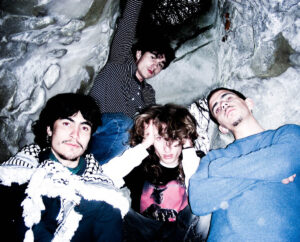
Gianluca Morando: guitars, voice, drums Renzo Sala: guitars, bass, keys, piano, programming Paolo Sala: guitars, bass, drums, voce, keys
The band Salinas from Genoa made their debut for Loretta Records in 2001, with an acoustic Tex-Mex sound inspired by Calexico and with self-deprecating and playful tones.
Given their success in live performances, the band released two more albums, in 2004 (Gonzalo Sorondo) and 2006 (Orange), expanding their style and evolving in the direction of indie rock.
After a long hiatus and various changes in the lineup (founding member Renzo Sala disappeared for a while, his brother Paolo Sala joined the band), a new album (Moon Eats Sun) was released in 2020.
In 2024, a new EP, Elegante Sonora, was released, featuring the complete line-up: Gianluca and brothers Renzo and Paolo.
Unfortunately, in April 2024, Paolo passed away.
Dark Architecture, the latest album to be released in September 2025, contains Paolo’s last performances on drums and vocals in some of the 11 tracks that make up the album.
Longtime friends Gianluca, Renzo and Paolo are historical figures in the Genoese underground scene, with numerous albums to their credit with the bands Age and Senpai.
What is your earliest memory connected to music?
I was born and raised in a very musical family, and I’ve been surrounded by music (classical, pop, rock) for as long as I can remember. But my earliest conscious memory connected to making music goes back to when I was four: my brother was eight and received a Beatles compilation as a gift from our aunt. Completely blown away, he decided he wanted to start a band—despite not being able to play yet—and his four-year-old little brother became the official drummer. Our drums were the living-room couch. We basically never stopped.
How did your passion for creating music begin?
Aside from that early episode, the real creative spark appeared when I started taking piano lessons at age six. Instead of practicing properly, I preferred inventing my own music as I slowly gained more technique and understanding. Creating something new felt far more exciting than playing something someone else had already written.
What’s the story behind your current music project?
Salinas started almost as a joke. My best friend Gianluca and I—after different musical experiences in separate bands (I played with my brother in Senpai, he played with Age)—decided it was finally time to make music together. It was 2001, and we wanted to create an indie band heavily inspired by Calexico, whom we had just discovered and instantly loved.
Since then, we’ve alternated studio periods (recording Texcalipoca and Gonzalo Sorondo as a duo), live periods (as a power trio: two guitars and a drummer who was a friend and a band’s fan, and also a good drummer), and later back to studio work for the most recent albums, after my brother Paolo joined as a multi-instrumentalist ten years ago.
Sadly, Paolo passed away suddenly this April, so now it’s back to just Gianluca and me, the way we started—although my sixteen-year-old son Toshi, another very talented multi-instrumentalist, has recently begun collaborating with us.
How would you describe your sound to someone who has never heard your music before?
The sound of Salinas has evolved a lot over time. It began, as mentioned, with tex-mex, lo-fi, indie pop/folk influences, then shifted toward indie rock (from Orange onward, shaped by our live experience). Our latest album, Dark Architecture (2025), is a kind of summa of everything we’ve explored so far: indie rock with crunchy electric guitars—sometimes harder, sometimes gentler and more arpeggiated—alongside more pop/tex-mex tracks featuring acoustic guitars, touches of piano, trumpets, and even Paolo’s signature instrument: the Andean charango.
What is one thing you’ve learned that completely changed the way you make music?
Tough question. Over time, I learned to play many instruments beyond piano—guitar, bass, drums. Among these, guitar became my favorite, and it fundamentally changed the way I compose.
With piano, ideas came directly from my head: I could easily translate what I imagined into sound, and the instrument’s “visual” nature helped. But when guitar entered my life, I learned to let myself be guided by its groove and even by chance—how certain harmonies emerge just by playing around with my fingers more than with my mind. You can stumble upon unusual, appealing chords and progressions more easily than on a linear piano keyboard.
So yes, getting comfortable with the guitar neck completely reshaped my creative process: now, 95% of my songs start from my Telecaster.
What tools, instruments, or software are essential in your creative process?
My first essential tool is simply having an instrument within reach—whatever it may be—and being able to play it comfortably. My current home setup includes six electric guitars, an acoustic guitar (I rotate them when looking for inspiration), a bass (which I mostly use only when recording), a drum set, and a piano.
I always have my laptop and Logic ready so I can record any idea quickly—whether it’s a rough piano take with simple mic setup or a guitar plugged in with a Logic amp stack.
Then comes the demo-recording phase, where I add basic arrangements that help shape and develop the track.
This applies to the songs I write. Gianluca’s songs usually begin with him grabbing an acoustic guitar and singing over it, improvising. When he feels he’s found something, he records it so he won’t forget it, and then we orchestrate it together in the studio.
Which indie artist or song are you loving right now?
Right now I’m deep into The Smile, and I’m exploring Nada Surf’s discography.
How have your personal experiences influenced your music and artistic vision?
You’d probably need to ask a psychologist! Honestly, I have no idea. My creative process is instinctive and hasn’t really changed in 35 years.
My music doesn’t carry a message, a moral, or a specific vision: it’s simply my personal search for something beautiful—very abstract. And that “beautiful something,” which is obviously subjective, comes mostly from what I’ve listened to throughout my life. My tastes range across classical, 60s pop/rock, late-70s punk, some 80s pop, 90s grunge, and post-rock from the 2000s onward.
Though I don’t have a specific genre I cling to—precisely to avoid blinders that would keep me from discovering something new—I do tend to stay away from the mainstream (anything that follows genre conventions too literally). I’ve always been drawn to music that is independent in spirit: independent from rules, genres, formulas, and marketing. That’s what “indie” means to me—a meta-genre encompassing many different sounds.
Did I digress?
What emotions or messages do you hope listeners take from your work?
This one is very simple: when I listen to something beautiful or sublime, I feel pure, total pleasure—I disconnect from reality and feel almost ecstatic. It has an almost physical component, yet it lifts you emotionally.
That’s what I hope listeners might experience when they stumble upon something in my music.
What’s the most important lesson music has taught you so far?
I’d say the deepest lesson is that music is joy, pleasure, and spiritual elevation. For that reason, in my opinion, it should be approached joyfully and never too seriously. With lightness—the way we treat the finest, most delicate pleasures in life.
What is a dream venue or festival you would love to perform at?
The rooftop of the Apple Corps headquarters—preferably in 1969.
If you could collaborate with any artist, past or present, who would it be and why?
My three dream collaborators would be Andy Partridge, Thom Yorke, and John Linnell. Though I’d probably be so intimidated that I’d perform at about 5% of my actual potential.
Where can our listeners follow and support your music? (Website, Spotify, IG, links)
Here are all the links:
YouTube: https://www.youtube.com/@musicofsalinas
Spotify: https://open.spotify.com/artist/5JuhJSbi64552GZe7VHhx1
Apple Music: https://music.apple.com/us/artist/salinas/1243392663
Bandcamp: https://salinasband.bandcamp.com
Instagram: https://www.instagram.com/salinas.band
Looking toward the future, what’s your dream for the next chapter of your musical journey?
To keep having fun making music with my lifelong friend. On the latest album, my son Toshi composed and played one track (Ashen Light). A very concrete dream would be seeing him become more and more involved in our project.
What do you hope listeners will discover about you along the way?
That even an indie band—far from the spotlight, original, and low-budget—can hide gems.
If you want here you can add a representative Youtube video to insert below the interview 🙂
I’d suggest Ashen Light—a perfect three-way collaboration between Gianluca, my son Toshi, and me. I also made a DIY video for it, in a very indie spirit:
https://www.youtube.com/watch?v=jy_9ARGEBsk